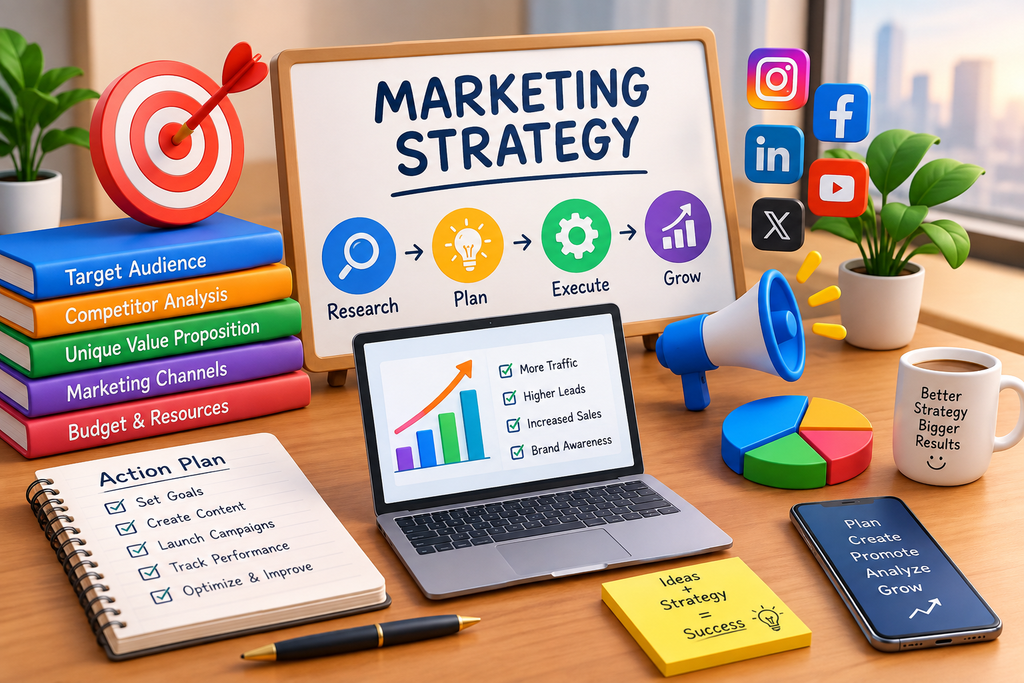
In today’s competitive business environment, having a great product or service is not enough. Businesses also need a clear plan to reach potential customers, communicate their value, and turn interested people into loyal customers. This is where a strong marketing strategy becomes important.
A well-planned marketing strategy helps businesses understand their target audience, choose the right marketing channels, create valuable content, and measure their results. Whether you run a small business, startup, e-commerce store, or large company, the right strategy can help you grow more effectively.
What Is a Marketing Strategy?
A marketing strategy is a long-term plan that explains how a business will reach its target customers and achieve its marketing goals.
It includes several important elements, such as:
- Identifying the target audience
- Understanding customer needs
- Researching competitors
- Defining business goals
- Creating a unique value proposition
- Selecting marketing channels
- Developing content
- Setting a marketing budget
- Measuring campaign performance
Simply put, a marketing strategy provides a clear direction for your marketing activities.
Why Is a Marketing Strategy Important?
Marketing without a strategy can lead to wasted time, money, and resources. A clear plan helps businesses focus their efforts on activities that are more likely to produce results.
1. Helps You Understand Your Customers
A good marketing strategy starts with customer research. Understanding your customers’ interests, problems, preferences, and buying behavior helps you create messages that are more relevant to them.
2. Builds Brand Awareness
Consistent marketing helps customers recognize your brand. Over time, strong branding can make your business more memorable and trustworthy.
3. Generates Leads
Marketing channels such as SEO, social media, email, and paid advertising can help attract people who are interested in your products or services.
4. Increases Sales
A well-designed marketing strategy guides potential customers through the buying journey, from discovering your brand to making a purchase.
5. Improves Marketing ROI
By tracking campaign performance, businesses can identify which channels are working and allocate their budget more effectively.
How to Create an Effective Marketing Strategy
Creating a marketing strategy becomes easier when you follow a structured process.
1. Define Your Marketing Goals
Start by deciding what you want to achieve.
Your goals could include:
- Increasing website traffic
- Generating more leads
- Increasing sales
- Improving brand awareness
- Growing your email list
- Increasing customer retention
- Entering a new market
Make your goals specific and measurable so that you can track progress.
2. Identify Your Target Audience
You cannot effectively market to everyone.
Define your ideal customer by considering factors such as:
- Age
- Location
- Interests
- Occupation
- Income
- Buying behavior
- Problems and needs
- Preferred communication channels
Creating a detailed customer persona can help your marketing team understand who they are trying to reach.
3. Research Your Competitors
Competitor analysis can reveal valuable information about your market.
Study your competitors’ websites, social media accounts, content, pricing, customer reviews, and promotional strategies.
Look for gaps in the market. Instead of copying competitors, find opportunities to offer something different or provide a better customer experience.
4. Define Your Unique Value Proposition
Your unique value proposition, or UVP, explains why customers should choose your business.
A strong UVP should answer three questions:
Who are you serving?
What problem are you solving?
Why should customers choose you?
A clear value proposition can help your brand stand out in a crowded market.
5. Choose the Right Marketing Channels
Every business does not need to use every marketing channel.
Choose channels based on your audience, goals, industry, and available resources.
Search Engine Optimization
SEO helps businesses attract organic traffic by improving their visibility in search engine results.
Content Marketing
Content marketing involves creating useful content such as blog posts, videos, guides, case studies, and infographics.
Social Media Marketing
Social media can help brands build awareness, engage with customers, share content, and create communities.
Email Marketing
Email marketing allows businesses to communicate directly with subscribers through newsletters, product updates, educational content, and special offers.
Paid Advertising
Paid advertising can help businesses reach targeted audiences quickly through search engines, social platforms, display advertising, and other channels.
6. Create Valuable Content
Content is an important part of modern marketing.
Instead of focusing only on selling, create content that helps your audience solve problems and make informed decisions.
For example, a digital marketing company could publish:
- SEO guides
- Marketing tips
- Industry trends
- Case studies
- Tutorials
- Marketing checklists
- Frequently asked questions
Useful content can attract visitors, build trust, and support conversions.
7. Optimize Your Website
Your website is often one of the most important parts of your marketing strategy.
Make sure your website is:
- Mobile-friendly
- Fast-loading
- Easy to navigate
- Secure
- Search-engine friendly
- Clear about your products or services
- Equipped with strong calls to action
Your website should make it easy for visitors to understand what you offer and take the next step.
8. Build a Strong Brand Identity
A strong brand is more than a logo.
Your brand includes your:
- Voice
- Colors
- Visual style
- Messaging
- Values
- Customer experience
- Unique positioning
Consistency across your website, social media, advertising, and other marketing channels helps customers recognize your business.
9. Set a Marketing Budget
A marketing strategy should include a realistic budget.
Your budget may cover:
- Advertising
- Content creation
- SEO
- Marketing software
- Social media
- Influencer campaigns
- Email marketing
- Design
- Marketing professionals or agencies
Start with channels that have the strongest potential for your target audience and measure their performance before increasing spending.
10. Track and Measure Results
A marketing strategy should be based on measurable results.
Important metrics include:
- Website traffic
- Leads
- Conversion rate
- Customer acquisition cost
- Sales
- Revenue
- Return on advertising spend
- Email click-through rate
- Social media engagement
- Customer retention
Regular measurement helps you understand what is working and what needs improvement.
Common Marketing Strategy Mistakes
Even a strong business can struggle with marketing if its strategy is unclear.
Trying to Reach Everyone
A broad audience can result in generic messaging. A clearly defined target audience usually makes marketing more effective.
Using Too Many Channels
Trying to maintain a presence everywhere can waste resources. Focus on channels where your target customers are most active.
Ignoring Existing Customers
Marketing should not only focus on acquiring new customers. Retention, loyalty, and repeat purchases are also important.
Creating Content Without a Purpose
Every piece of content should support a specific business or customer goal.
Not Tracking Performance
Without data, it is difficult to know which campaigns deserve more investment.
Marketing Strategy vs. Marketing Plan
Although the terms are often used together, they have different meanings.
A marketing strategy defines the overall direction of your marketing efforts.
A marketing plan explains the specific actions you will take to execute that strategy.
For example:
Strategy: Increase brand awareness among young professionals.
Plan: Publish three educational articles per month, run social media campaigns, collaborate with relevant creators, and measure website traffic and engagement.
Final Thoughts
A successful marketing strategy gives your business a clear roadmap for reaching customers and achieving growth. It starts with understanding your audience and competitors and continues through content creation, channel selection, branding, promotion, and performance measurement.
The most effective strategies are not fixed forever. Customer preferences, technology, competitors, and market conditions continue to change. Businesses should regularly analyze their results, test new ideas, and improve their approach.
Whether you are launching a new business or trying to grow an established brand, a clear marketing strategy can help you turn marketing activities into measurable business results.